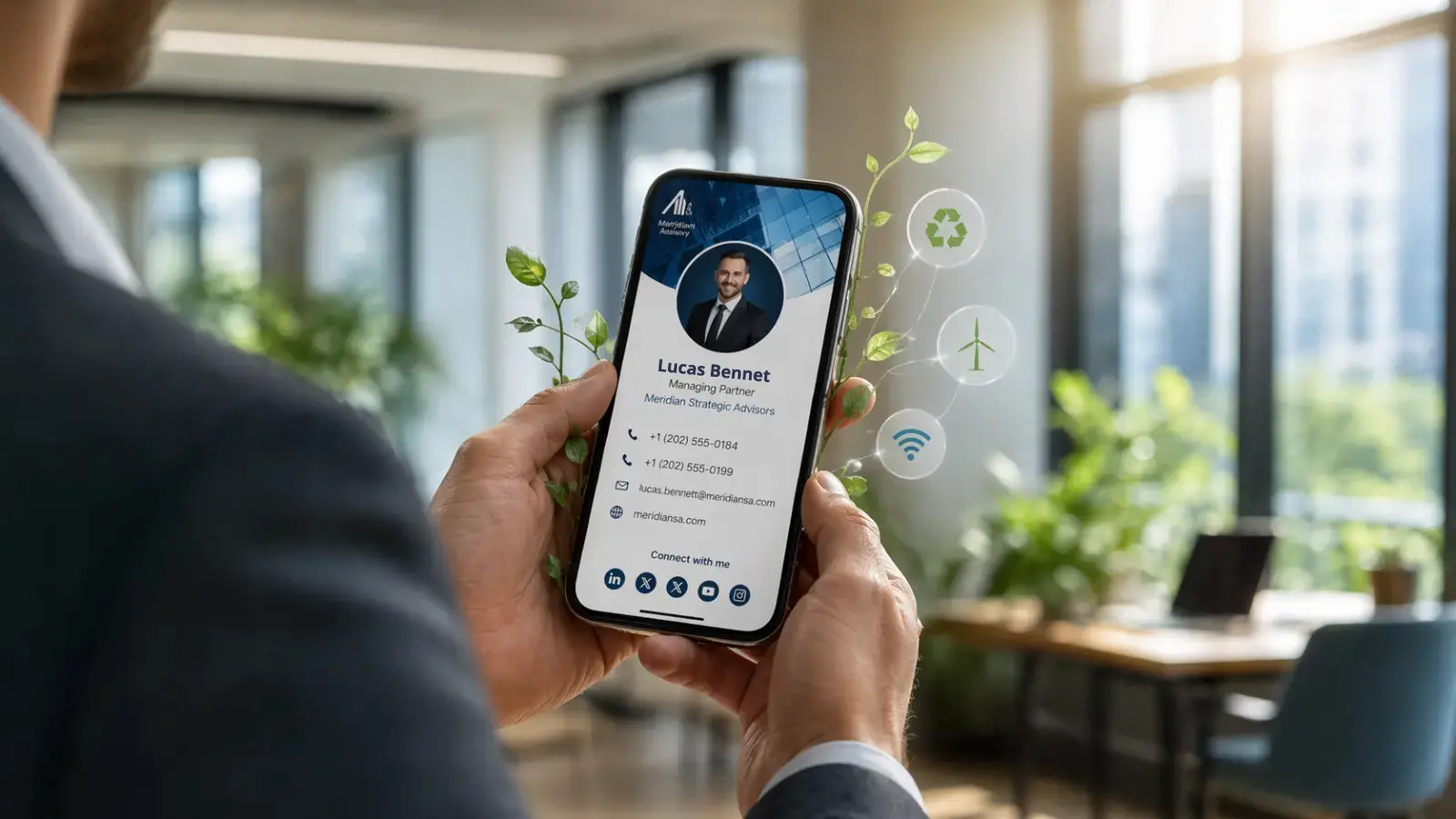
Digital Business Card: Sustainable Entrepreneurship
Discover how a digital business card can strengthen sustainable entrepreneurship, reduce paper use, and showcase a more environmentally conscious brand.

In today’s landscape, where consumers, investors, and business partners value brands committed to the future of the planet, sustainable entrepreneurship has evolved from a trend into a strategic necessity.
Companies of all sizes are looking to integrate responsible practices into their positioning, including in the smallest details, such as how they present their professional identity to the market.
It is in this context that the digital business card emerges as a modern, versatile, and environmentally friendly solution.
In addition to replacing printed paper cards, it offers interactive features, improves user experience, and strengthens the image of a brand aligned with new social and environmental demands.
In this article, you will learn what sustainable entrepreneurship means and how to create a digital business card that truly expresses this commitment and strengthens your market presence.
What Is Sustainable Entrepreneurship?
Sustainable entrepreneurship means building a business that makes a profit while also taking care of the environment and the people it affects. Instead of measuring success by revenue alone, sustainable entrepreneurs weigh three results at once, often called the triple bottom line: people, planet, and profit. The British business writer John Elkington coined the term in 1994.
It sits close to two related ideas. Green entrepreneurship focuses mainly on environmental impact, such as clean energy, recycling, or low-waste products. Social entrepreneurship focuses mainly on social problems, such as access to education or health care. Sustainable entrepreneurship brings both together and applies them to everyday decisions in any kind of business, not only in green industries.
In practice, it shows up in choices like these:
Cutting waste in daily operations, from paper to packaging
Choosing suppliers with responsible practices, often local ones
Replacing physical processes with digital ones where it makes sense
Treating employees, customers, and the community fairly
Being transparent about what the company already does and what it is still working on
Many sustainable businesses are also digital from day one, and the two approaches reinforce each other. If that sounds like your company, our guide to digital entrepreneurship covers the online tools that help a small business win clients.
Why Is a Digital Business Card a Sustainable Choice?
Physical business cards, even when printed on recycled paper, require printing, ink, and delivery, and many end up in the trash after minimal use. A digital business card removes those steps:
No paper or ink: there are no boxes of cards to print, ship, or throw away.
Quick updates: you edit your details instead of reprinting a whole batch.
Unlimited sharing: each new contact costs nothing and produces no new material.
Many ways to share: a QR code, a link, a PDF, or a tap of an NFC card.
It also helps the profit side of the triple bottom line: fewer reprints mean lower costs and less time spent on materials that go out of date. Small actions like this one shape how customers see your brand, too, since more and more of them value companies that cut waste.
For the full environmental case, see how sustainable technology is cutting paper waste in networking, or whether an eco-friendly business card is really possible.
The Importance of Aligning Visual Identity and Purpose
Creating a digital business card goes beyond simply digitizing information: it means translating your sustainable identity into visual and textual elements.
To achieve this, consider the following:
1. Sustainability-Inspired Color Palette
Shades of green, brown, sand, and blue naturally evoke nature, but you are not limited to these colors. The most important aspect is that the colors communicate balance and responsibility. Neutral, minimalist, and soft tones are excellent choices.
2. Clean and Purposeful Design
Sustainable design values clarity, purpose, and functionality. Avoid excessive visuals or disconnected elements. A minimalist layout reinforces your commitment to simplicity and efficient resource use.
3. Modern and Readable Typography
Choose clean, harmonious fonts that communicate professionalism. Combining modern typography with a well-organized layout strengthens your sustainable image.
4. Positive-Impact Images and Icons
Icons representing renewable energy, recycling, social responsibility, or green technology help communicate your brand positioning.
5. Consistency Between Message and Appearance
In sustainable entrepreneurship, authenticity is essential. There is no point in creating a “green” aesthetic if the company’s communication does not reflect genuine values. Your digital business card should mirror real sustainable practices and maintain consistency between aesthetics and purpose.

What Information Should Be Included in Your Sustainable Digital Business Card?
Functionality is a key element in sustainable entrepreneurship. Therefore, your business card should be intuitive, direct, and useful.
Essential Elements
Full name
Position or specialization
Logo or personal branding
Phone number and WhatsApp
Email address
Website or portfolio
Social media profiles
Scheduling link (if applicable)
QR code directing users to a useful page
Unlike physical cards, digital business cards are not limited by space. You can include clickable buttons that simplify contact and expand your networking opportunities. This practicality improves user experience and reinforces your sustainable approach.
Another interesting possibility is adding links to institutional presentations, explanatory videos, product catalogs, or service pages. This transforms your business card into a true connection hub and facilitates access to your company’s main information.
How to Communicate Your Commitment to Sustainable Entrepreneurship Through Your Business Card
Beyond design, you can strengthen your message with strategic content inside your digital business card. Here are some ideas:
1. Add a Sustainable Mini-Slogan
Examples include:
“Entrepreneurship with environmental responsibility”
“Innovation with positive impact”
“Solutions that respect people and the planet”
2. Include Certifications or Badges
If your company holds certifications such as green labels, ESG credentials, ISO certifications, or environmental responsibility programs, include a small icon or link.
3. Add Links to Sustainability Reports or Practices
You can also include links to:
Sustainability policies
Social and environmental projects
ESG commitments
Educational materials about positive impact
4. Highlight Eco-Friendly Materials and Processes
If you sell products, mention sustainable materials.
If you provide services, emphasize ethical, digital, and low-impact processes.
5. Showcase Your Company’s Positive Impact
Many sustainable businesses support social projects, work with local suppliers, or offset carbon emissions. These initiatives can be subtly presented on your digital business card, strengthening emotional connections with clients and partners.
The Role of Technology in Sustainable Entrepreneurship
Technology is one of the main allies of sustainable entrepreneurship. Digital solutions help businesses reduce waste, improve communication, and create more efficient experiences for their audiences.
The digital business card perfectly represents this evolution. Instead of depending on physical materials, storage, and traditional distribution, entrepreneurs can centralize everything into an accessible and intelligent solution.
Additionally, technologies such as dynamic QR codes, social media integration, NFC, and interactive pages make contact exchange much faster and more modern. This improves user experience and demonstrates that your company keeps up with innovation trends.
Businesses investing in digital transformation can also measure results more effectively, understand audience behavior, and optimize relationship strategies. In other words, sustainability and technology go hand in hand in building more efficient businesses prepared for the future.
Best Practices for Creating a Sustainable Digital Business Card
1. Use Platforms That Prioritize Resource Efficiency
Platforms that optimize images, reduce file sizes, and offer clean layouts contribute to the concept of efficiency.
2. Invest in Accessibility
A business card aligned with sustainable entrepreneurship should also include inclusive practices:
Adequate contrast
Readable fonts
Alternative text for images
Intuitive buttons
3. Prefer Short Links and Editable QR Codes
This simplifies sharing without the need to generate new digital materials.
4. Update Information Regularly
The longevity of a digital business card depends on maintenance. Update information whenever necessary to avoid communication issues.
5. Avoid Information Overload
Although digital business cards allow many resources, it is best to focus on the essentials. Too much information can harm navigation and reduce communication clarity.

How Digital Business Cards Improve Customer Experience
Another major advantage of digital business cards is the experience they provide to users. In just a few clicks, people can access your contacts, social media profiles, location, and customer service channels.
This reduces communication barriers and facilitates relationships with clients, partners, and suppliers.
Additionally, digital cards eliminate common issues associated with physical cards, such as loss, wear and tear, or outdated information. Everything remains centralized in a modern and easily shareable environment.
In the context of sustainable entrepreneurship, offering convenience to your audience is also part of building a responsible and innovative brand.
How to Share Your Business Card Sustainably and Strategically
One of the greatest advantages of digital business cards is their ease of distribution. You can use them in:
Email marketing campaigns
Email signatures
Social media profiles
Commercial presentations
QR codes on packaging, reusable materials, or service points
This strategy strengthens your online presence and eliminates the need to print thousands of physical business cards throughout the year. It is a simple practice that reinforces your commitment to sustainable entrepreneurship while increasing visibility.
Another efficient strategy is including the card’s QR code at events, trade shows, and networking meetings. This allows instant, modern, and waste-free sharing.
Sustainable Entrepreneurship as a Competitive Advantage
Businesses that adopt sustainable practices gain important competitive advantages in today’s market. Consumers are increasingly attentive to brand impact and tend to prioritize companies that demonstrate environmental and social responsibility.
In this scenario, even simple tools such as a digital business card help strengthen a company’s positioning.
Sustainable entrepreneurship does not depend solely on major investments. Often, small changes generate significant impacts on brand perception and waste reduction.
Moreover, sustainable businesses tend to create stronger connections with younger and more digitally connected audiences, especially consumers who value innovation, purpose, and corporate responsibility.
Why Does a Digital Business Card Strengthen Your Image as a Sustainable Entrepreneur?
In addition to reducing environmental impact and demonstrating modernity, digital business cards reinforce important attributes for any sustainable brand:
Transparency
Innovation
Accessibility
Responsibility
Credibility
By integrating technology and purpose, you demonstrate that your commitment is real, practical, and present in everyday operations.
Creating a digital business card that reflects your sustainable entrepreneurship is a smart way to combine purpose, innovation, and branding strategy. This modern tool not only reduces environmental impact but also helps position your company as a model of social and environmental responsibility.
Whether through minimalist design, conscious visual elements, or the way you share your contact information, every detail tells the market who you are and the kind of impact you want to create in the world.
With the right digital business card, you do more than facilitate connections: you transform your professional presentation into an extension of your commitment to the future.
Create your free digital business card in the ClickCard web app today, or talk to our team if you want to roll it out across your company.