Most digital entrepreneurship advice still reads like it was written for 2019: pick a niche, build a website, post on LinkedIn. That ladder still works, but the rung that decides whether your business actually grows in 2026 is the one almost nobody talks about — the system you use to convert a single introduction into a paying client.
AI agents now write your competitors' cold emails. Discovery happens inside ChatGPT, Perplexity, and TikTok before a buyer ever sees your homepage. The default web of inbound traffic is shrinking, and warm introductions, referral chains, and direct conversations are quietly becoming the most reliable revenue channel a solo founder has. The question is whether your stack is built to capture them.
This guide lays out what digital entrepreneurship looks like right now, why a digital business card has become the connective tissue of a modern solo operator's stack, and how to assemble a networking system that turns every handshake — physical or virtual — into measurable growth.
Digital entrepreneurship is no longer code for "tech founder." It now describes anyone whose business is discovered, sold, or delivered through online channels: a Shopify operator, a fractional CMO, a YouTube educator, a Notion template seller, a freelance developer running a one-person agency, an AI consultant who closes six-figure retainers from a laptop in Lisbon.
Three forces have moved this model from edge case to mainstream:
Distributed buyers. Your next client may live in another time zone, find you through a Reddit thread or an AI Overview, and never set foot in your city.
Frictionless launches. A solo founder can ship a paid offer in a weekend with Stripe, a no-code stack, and a Loom. Speed of iteration replaces capital as the moat.
Trust is built before contact. Buyers research you across LinkedIn, podcasts, communities, and AI assistants before they reply. The first message you receive is rarely the first impression you make.
In that environment, every asset that represents you needs to be as mobile, measurable, and memorable as the business itself. Static brochures and dead-end "link in bio" pages are not just outdated — they are leaks in your funnel.

Most founders already own the obvious assets: a portfolio, a LinkedIn profile, a landing page, a link-in-bio tool, maybe a newsletter. So why does so much pipeline still slip through the cracks?
Because none of those assets is engineered for the moment of introduction. A landing page sells. A portfolio archives. LinkedIn broadcasts. Link-in-bio curates. None of them is designed to do what a digital business card does in one tap: convert a handshake into a saved phone contact, tagged with every channel you want the conversation to continue on.
The quality of your network compounds faster than almost any other lever in a digital business. Conferences, Zoom rooms, Slack DMs, podcast guest spots, accelerator intros — every one of them ends with the same quiet question: "How do I stay in touch with this person?" Whatever you hand over in that moment becomes part of your brand. A paper card is forgettable. A typed-out WhatsApp number is forgettable. A polished, on-brand digital profile dropped straight into someone's contacts is not.
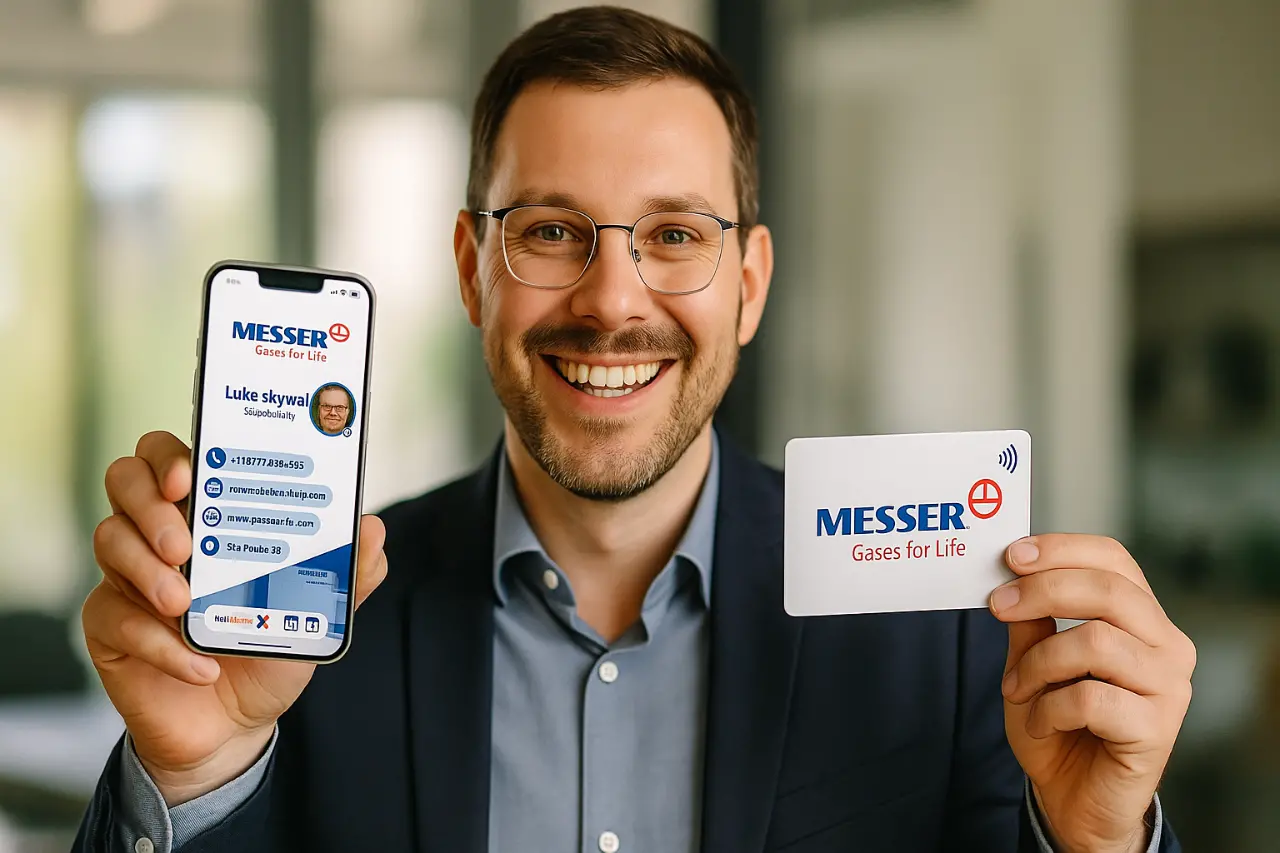
A digital business card is a shareable profile that bundles your identity, your channels, and your call-to-action into one link, QR code, NFC tap, or email-signature ribbon. The recipient saves your full contact to their phone in one gesture — name, role, photo, links, and a primary CTA all carried over.
The 2026 version goes further. It is not just a digital alternative to paper. It is a thin, on-brand interface to your entire funnel: a CTA that opens a Calendly, a tap that drops the lead into your CRM, a public profile that ranks for your name on Google, an analytics layer that tells you which introductions are worth following up on first.
| Asset | Best for | Weakness |
|---|
| Paper card | Sentimental keepsake, regulated industries | Static, costly to update, easily lost |
| Link in bio | Social distribution of content | Cannot be saved as a phone contact |
| Digital business card | Converting introductions into saved leads | Requires intentional design, like any conversion asset |
Whether the meeting happens at a conference, in a Zoom breakout, or in a Twitter DM, one shared link drops your name, role, links, and photo straight into the recipient's phone. No misspelled emails. No blurry photos of handwritten phone numbers. The follow-up window stays open.
The card carries your logo, colors, headshot, and tone. The same identity a prospect saw on your landing page is reinforced the moment they save your contact — quiet but powerful brand recall, exactly when memory is being filed away.
Email wins for proposals. WhatsApp wins for quick questions. Calendly wins for booking. Instagram, LinkedIn, TikTok, YouTube, Substack — every audience has a default. A digital card hands them all over in one motion and lets the prospect choose their preferred path.
Change your title, add a service, or rebrand the company? Edit once and every QR code or link already in the wild reflects the change. Paper cards become obsolete the day they leave the printer.
Modern platforms (ClickCard included) report views, clicks, geographic distribution, and which CTAs convert. That feedback loop is rare gold for a solo marketer trying to optimize outreach with no analytics team.
In 2026, pulling a creased paper card from a wallet says one thing about how your business runs. Tapping a phone to share a polished profile says another. In competitive categories, that first signal often decides whether the conversation continues.
A strong card is not an island. It points at your booking page, your lead magnet, your newest case study, your checkout. Used well, it is the top of a funnel that runs almost on autopilot. See how flexible the surface can be on the ClickCard features page.

Owning a digital business card is the easy part. Operating it like a system is what separates founders who collect contacts from founders who collect clients. Here is a 90-day cycle worth stealing.
Design a card that leads with one job — the action that drives revenue this quarter (book a call, request a quote, claim a free audit).
Add the QR code to your laptop sticker, Zoom background, email signature, and Instagram link in bio.
Order an NFC card for in-person meetings; tap-to-share converts dramatically better than typing a URL.
Connect your card analytics to a simple weekly review (Notion or a spreadsheet works).
Share your card at every meeting, podcast appearance, and community intro for one full month — no exceptions.
Tag introductions in your CRM by source: event, referral, content, cold inbound. Patterns will surface fast.
Run an A/B test on your primary CTA. "Book a discovery call" vs. "Get a free 15-minute audit" can swing conversion meaningfully.
Set a 48-hour follow-up rule for every saved contact: a personalized voice note or message, never a generic template.
Build a one-pager (a Notion doc works) that you can attach to every follow-up — case study, pricing, calendar link.
Review analytics monthly: which channel produced the highest-quality leads, and where did good conversations die?
Founders who run this loop for two quarters typically discover their pipeline is not a traffic problem. It is a memory problem solved by better hand-off.

Uses the card as the close of every discovery call and speaking gig. Primary CTA is a Calendly link; secondary CTA points to a recent case study. Every introduction becomes a calendar invite without an email chase.
The content creator
Optimizes for channel growth and brand inquiries. The card foregrounds YouTube, newsletter, Patreon, and a sponsorship inquiry form, turning every audience interaction into a potential business deal.
Uses the card at trade shows, pop-ups, and supplier meetings. Primary CTA drives wholesale inquiries; secondary CTAs surface the storefront and the Instagram catalog. The card becomes the bridge between offline encounters and online checkout.
Equips themselves and their first sales hires with team cards. Each card pushes to a personalized demo form and a one-pager deck. The lift in demo-to-close rate is small but real, and it compounds across every rep.
Phone-native save. The card should add to iOS and Android contacts in one tap, with no app required on the recipient's side.
Custom branding. Logo, colors, photo, typography, and layout should feel like your brand — not a template with your name swapped in.
Multiple share methods. Link, QR, NFC, and email signature, at minimum.
Real analytics. Views, clicks, geography, and CTA conversion — not vanity totals.
Unlimited edits. Update fields without breaking prior QR codes or reissuing cards.
Team support. When you grow, the platform should issue branded cards across the whole team.
SEO-friendly public profile. A public card page helps you capture branded searches on Google.
Integrations. CRM, calendar, and lead-capture forms should connect without engineering effort. Compare options on the ClickCard pricing page.

Stuffing the card with eight CTAs. Two CTAs convert better than eight every time. Pick the one action that matters this quarter and let it own the visual hierarchy.
Skipping the photo. A face attached to the contact dramatically increases follow-up. A warm headshot is not vanity — it is retention.
Treating the card as set-and-forget. If you never check analytics, you forfeit the optimization advantage that makes digital cards different from paper.
Inconsistent branding. The card is often the first thing a prospect saves about you. Mismatched colors and an old job title undermine every other signal you send.
Ignoring the follow-up. The card opens the door. The 48-hour message is what walks the prospect through it.
If your customers, marketing, and brand already live online, yes. A digital business card is faster to share, free to update, measurable, and aligned with how buyers expect to interact in 2026. Many entrepreneurs still keep a small stock of printed cards for specific occasions, but use the digital version as their default.
No. Plenty of early-stage founders use a digital business card as a lightweight website while they build something more permanent. A well-designed card holds a bio, social proof, CTAs, and a booking link — enough to run a lean operation from day one.
QR is the universal bridge. Any modern phone camera reads it and opens the card in the browser, no app required. You can also send the link by WhatsApp, SMS, or email — each method takes seconds.
Review it every quarter. Update immediately when you change roles, raise a price, launch a new offer, rebrand, or add a channel. The quiet superpower of a digital card is that these updates take minutes, not a reprint cycle.
For very early-stage founders, almost. The analytics on a quality card platform can substitute for a CRM until you cross roughly 50 active conversations per month. Beyond that, pair the card with a lightweight CRM (Notion, Attio, or HubSpot Free) so follow-ups never slip.
For founders who meet people in person, yes. The conversion uplift from "tap my card to your phone" versus "let me text you a link" is real, especially at events where attention is short. Most platforms, ClickCard included, let one digital profile power a link, a QR, and an NFC card simultaneously.

Digital entrepreneurship rewards the founders who treat every introduction as the first move in a longer game. Your website earns trust. Your content earns attention. Your digital business card is what closes the loop between the two — the asset that makes sure the conversation actually continues.
If you are ready to give your next introduction the first impression it deserves, build a ClickCard in minutes, share it via link, QR, or NFC, and let the analytics tell you what is working. See plans and start a card, and turn your network into your most reliable growth channel.