In 2026, sustainable technology is no longer just a corporate talking point, it is a heavily scrutinized, measurable expectation. As climate disclosure mandates tighten and ESG reporting becomes standard practice, the landscape has shifted. Investors now screen portfolios with rigorous ESG filters, consumers compare the environmental track record of competing brands, and employees increasingly prefer employers whose operations match their values. For business leaders, the pressure is immediate and real: cut environmental impact without slowing innovation or inflating costs.
The good news is that meaningful change doesn't always require a major infrastructure overhaul. Some of the most effective shifts happen in the everyday tools we take for granted — starting with the humble business card. Swapping paper for a digital business card is a small change with a surprisingly large compound effect, and it's one of the clearest examples of sustainable technology in daily use.
What is sustainable technology?
Sustainable technology is any tool, product, or process designed to deliver economic value while minimizing environmental harm. It spans clean energy systems, circular manufacturing, resource-efficient software, and digital platforms that replace physical, single-use materials.
The common thread is decoupling progress from waste. Instead of treating growth and environmental impact as inseparable, sustainable technology uses smarter design to reduce emissions, cut raw-material use, and extend the life of the resources we already have.
Why sustainable technology matters for modern businesses
Adopting sustainable technology used to be framed as a cost — a concession to regulators or public pressure. That framing is outdated. Today, sustainability sits on the same balance sheet as revenue, retention, and reputation.
Three forces make it a practical priority:
ESG investor pressure: public and private capital increasingly flows toward companies with credible environmental programs.
Operational savings: digital-first, low-waste workflows typically cut printing, logistics, and disposal costs.
Brand trust: audiences reward companies that back sustainability claims with visible, everyday actions — not just annual reports.
Businesses that embed sustainable technology into their operations don't just look greener; they tend to run leaner and build stronger customer relationships in the process. A deeper view of what this looks like in practice is available in our environmental responsibility guide for companies.
The hidden environmental cost of paper business cards
Paper business cards feel harmless because each one is small. The problem is scale. Billions are printed every year, and industry observations suggest that 88% of paper business cards are thrown away within a week of being received, often before the contact is ever saved to a phone.
Behind each card sits a full production chain:
Harvested wood pulp and freshwater used in paper manufacturing.
Petroleum-based inks, laminates, and plastic coatings.
Fuel burned to ship blank stock to printers and finished batches to offices.
Landfill volume from cards that were never reused or recycled.
Multiply that across a single trade show, and the footprint stops looking trivial. For a business claiming sustainability credentials, a drawer full of paper cards quietly works against the message.

How digital business cards embody sustainable technology
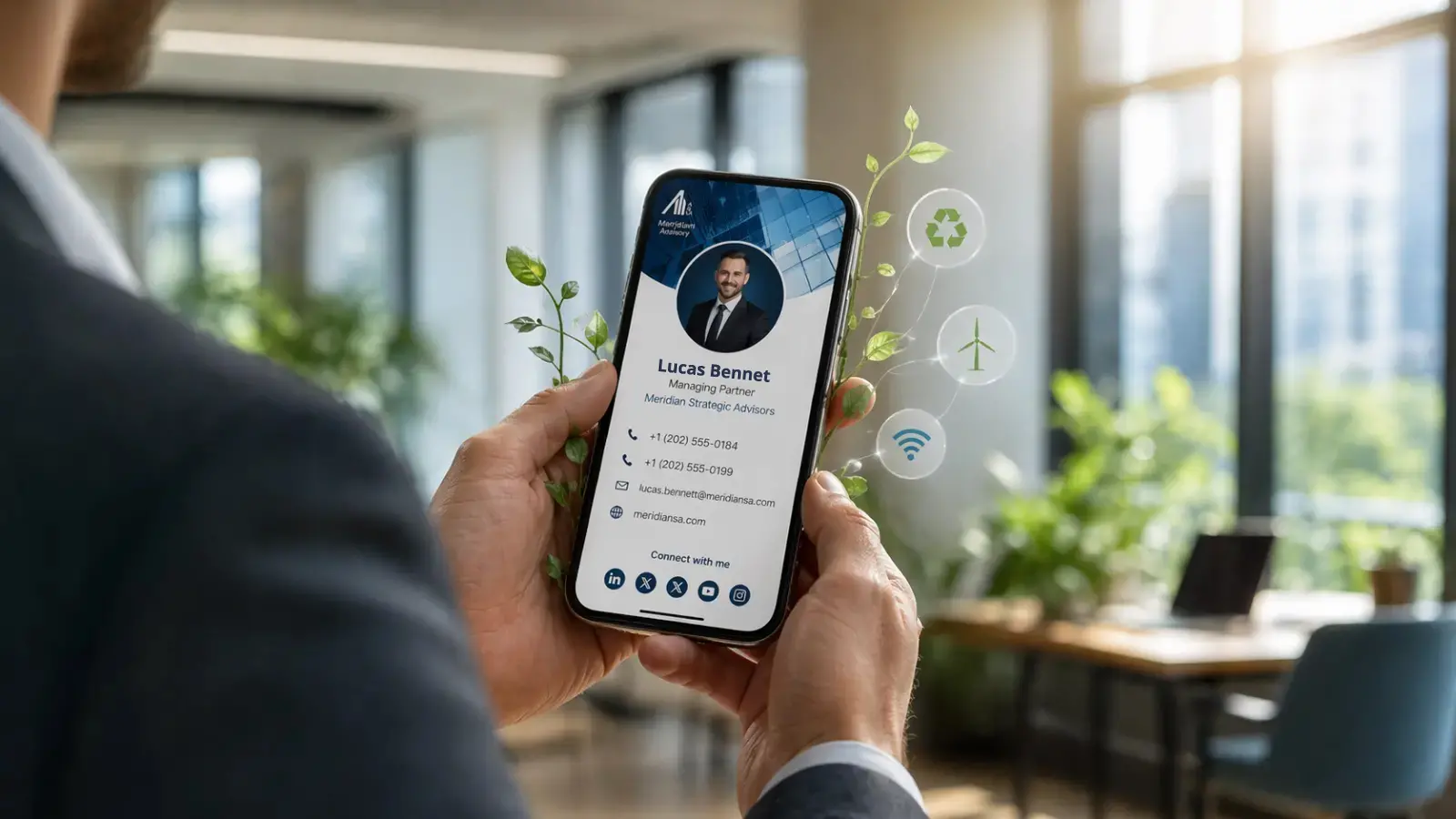
A digital business card is a shareable online profile — contact details, links, portfolio, and calls to action — exchanged through a QR code, NFC tap, or link. Nothing is printed, nothing is shipped, and nothing ends up in a bin.
That makes it one of the cleanest real-world examples of sustainable technology:
Zero physical material is consumed per share.
No reprinting is required when a role, phone number, or logo changes.
The medium is richer: one digital card can host a portfolio, video intro, scheduling link, and multiple channels — replacing several paper assets at once.
It's not just "less paper." It's a fundamentally more efficient information exchange, built on infrastructure that is already running.
Paper vs digital business cards: an environmental comparison
| Factor | Paper business card | Digital business card |
|---|---|---|
| Raw materials | Wood pulp, ink, coatings | None per share |
| Updates | Full reprint required | Instant, unlimited edits |
| Typical lifespan | Days to weeks | Years, continuously updated |
| Shipping footprint | Printer → office → event | None |
| End of life | Landfill or recycling stream | No physical disposal |
| Cost per share at scale | Ongoing | Near-zero after setup |

Side by side, the case for going digital stops being a sustainability talking point and becomes a basic operational upgrade.
Real benefits of switching to a digital business card
The environmental story is the headline, but the day-to-day gains are just as persuasive:
Always up to date. Change a title, number, or social link once, and every past and future share reflects it automatically.
Faster exchanges. A QR code scanned from a phone is quicker than finding a card in a wallet, and the contact lands directly in the recipient's device.
Richer first impression. Links to your portfolio, calendar, WhatsApp, and LinkedIn turn a single tap into a full introduction.
Lower recurring cost. No reprints when you rebrand, change roles, or expand the team.
Consistent brand across the team. Centralized design keeps every employee's card on-brand without chasing down old templates.
If you're actively reshaping your networking playbook, our guide to digital reputation pairs well with this one.
Sustainable technology and ESG: the new competitive edge
ESG reporting is moving from optional to expected. Small, visible actions carry disproportionate weight because stakeholders — customers, partners, job candidates — can verify them without reading a 60-page report.
Replacing paper cards with a digital equivalent is exactly that kind of action. It is a concrete, auditable switch that:
Reduces the Scope 3 emissions associated with printing and shipping.
Removes a recurring single-use material from company operations.
Sends a consistent sustainability signal every time an employee shares their contact.
In the wider context of digital transformation and sustainability, the digital business card is a rare initiative that improves sustainability, operations, and brand perception at the same time — with no real trade-off.

How ClickCard fits into your sustainable technology strategy
ClickCard is built around this exact intersection: professional networking that costs nothing to the planet to share. Each card is fully customizable — logo, colors, links, portfolio — so your digital identity matches your brand instead of relying on a generic template.
For teams, ClickCard removes the recurring waste cycle that comes with role changes and rebrands. For individual professionals, it turns a single QR code into a living profile that keeps working long after the meeting ends. For your sustainability reporting, it is one more measurable switch from physical to digital — the kind of consistent, everyday change ESG audiences trust.
Frequently asked questions
What is sustainable technology in simple terms?
Sustainable technology is any tool or process designed to deliver economic value while reducing environmental impact. It covers clean energy, circular manufacturing, and digital platforms that replace single-use physical materials with more efficient alternatives.
Are digital business cards actually more sustainable than paper?
Yes. Digital business cards require no paper, ink, or shipping per share, can be updated without reprinting, and avoid landfill disposal entirely. Across the lifetime of a career or brand, the difference in resource use is substantial.
Can a digital business card support ESG reporting?
It can. Switching from paper to digital removes a recurring single-use material and reduces the Scope 3 emissions tied to printing and shipping — small but measurable wins that contribute to company-level ESG metrics.
Is ClickCard suitable for both individuals and companies?
Yes. ClickCard supports individual professionals who want a stronger personal brand, and companies that need consistent, centrally managed digital cards for every team member, with shared design standards.
Do I need an app to share or receive a digital business card?
No. ClickCard cards are shared through a link or QR code, and the recipient opens them in any standard web browser. No app download is required on either side of the exchange.

Ready to align your networking with your sustainability goals? Create your ClickCard digital business card and turn every introduction into a small, visible win for the planet.

Enjoyed this article? Follow us on Google