In 2026, your company's first impression rarely happens face to face. It happens on a search engine results page, inside an AI-generated summary, or through a quick scroll of online reviews. That collection of signals — every comment, rating, article, and social interaction tied to your brand — forms your digital reputation.
And it is no longer optional to manage it. Businesses that treat digital reputation as a strategic priority consistently outperform those that ignore it. Research continues to show that the vast majority of consumers check online reviews and search results before they commit to a purchase, hire a service provider, or enter a partnership. A single negative result on page one can quietly turn away a significant percentage of prospective customers before you even know they existed.
The stakes are clear: a well-managed digital reputation builds trust, attracts opportunities, and strengthens your bottom line. A neglected one does the opposite — and the damage often spreads faster than you can contain it.
So, what exactly shapes this reputation, and how can a tool like ClickCard help you take control of it?
What Is Digital Reputation?
Digital reputation is the overall perception that people form about your business based on what they find online. It includes everything from Google reviews and social media mentions to blog articles, press coverage, forum discussions, and even the results that AI assistants surface when someone asks about your company.
Unlike traditional word-of-mouth, digital reputation is persistent and searchable. A review posted three years ago can still influence a buying decision today. A social media interaction — positive or negative — can be screenshot, shared, and amplified within hours.
What makes this especially important right now is how the landscape has evolved. Search engines are no longer the only gateway. AI-powered tools like ChatGPT, Google Gemini, and Perplexity now pull from the same pool of web content to generate answers about brands. If the information available about your business is thin, outdated, or negative, these systems will reflect that — and millions of people will see it without ever visiting your website.
That is why digital reputation management has shifted from a reactive "damage control" exercise to a proactive, always-on business function.
Why Does Digital Reputation Matter So Much for Businesses?
The connection between online perception and revenue is well documented. Here is why it deserves serious attention:
Trust Drives Decisions
Consumers routinely research brands online before spending money. They look at ratings, read reviews, and assess how companies respond to feedback. A strong digital reputation signals reliability and professionalism — two factors that directly influence whether a prospect converts into a paying customer.
Visibility Feeds Growth
Search engines and AI systems prioritize content from brands that demonstrate expertise, authority, and trustworthiness. A positive online presence does not just protect your image; it makes your business easier to find. Better visibility means more organic traffic, more leads, and more opportunities — without increasing your advertising budget.
Negative Impressions Compound Quickly
A single bad review or unflattering article might seem manageable on its own. But when negative content goes unanswered, it tends to attract more negative content. Competitors rank above you. Prospects choose alternatives. Talented professionals apply elsewhere. Over time, the cost of inaction compounds far beyond what proactive management would have required.
Partnerships and Talent Depend on Perception
It is not only customers who research your company online. Potential partners, investors, and job candidates do the same. A strong digital reputation can be the deciding factor in whether a strategic partnership moves forward or a top candidate accepts your offer.
How ClickCard Strengthens Your Digital Reputation
This is where practical tools make a measurable difference. ClickCard's digital business card platform addresses several critical elements of digital reputation, all from a single, easy-to-manage solution.
Project a Professional, Modern Image
First impressions in business networking now happen digitally — through a shared link, a QR code scan, or an NFC tap. ClickCard lets you create polished, fully branded digital business cards that immediately communicate professionalism and attention to detail. With over 118 customizable templates and the ability to incorporate your company's exact colors, logos, and design language, every interaction reinforces your brand identity.
This consistency matters. When your team members share cards that look cohesive and well-designed, it signals that your organization takes its image seriously — a perception that extends directly to your digital reputation.
Keep Your Information Always Accurate
Outdated contact information is one of the most common — and most avoidable — reputation risks. A prospect who encounters a disconnected phone number, a wrong email address, or an outdated job title forms an immediate (and negative) impression.
With ClickCard, updates happen in real time. Change a phone number, add a new social profile, or update a job title, and every card across your organization reflects the change instantly. No reprints, no inconsistencies, no missed connections. This accuracy reinforces reliability, which is foundational to a trustworthy digital reputation.
Expand Your Visibility Through Seamless Sharing
Digital reputation is partly a function of reach — the more touchpoints people have with your brand, the stronger the impression. ClickCard supports sharing through QR codes, NFC, custom links, email, social media, WhatsApp, Apple Wallet, Google Wallet, and more.
Each share is an opportunity to drive traffic to your website, your LinkedIn profile, or your Google Business listing. These interactions create signals that search engines and AI platforms interpret as indicators of an active, engaged brand — which can positively influence how your business appears in search results.
Demonstrate Environmental Responsibility
Sustainability is no longer a niche differentiator; it is a baseline expectation for many consumers and business partners. By replacing paper business cards with a digital alternative, your company reduces waste, eliminates the environmental cost of printing and shipping, and demonstrates a commitment to responsible business practices.
This is more than a feel-good gesture. Sustainability-conscious consumers actively seek out brands that align with their values. Choosing ClickCard sends a visible signal that your organization walks the talk on green technology — another meaningful layer added to your digital reputation.
Gain Data-Driven Networking Insights
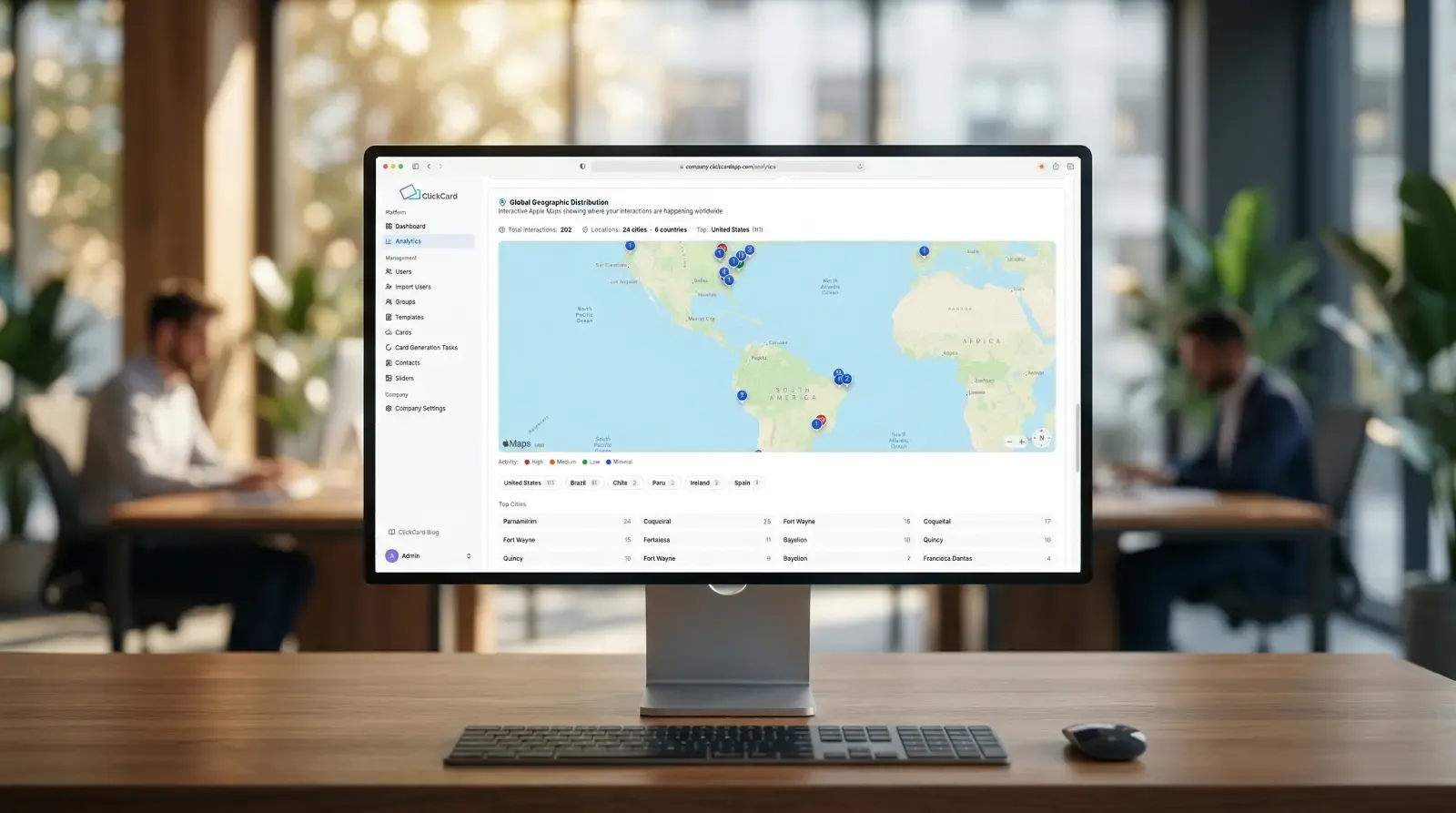
ClickCard provides analytics that track card views, shares, QR scans, NFC taps, and contact saves. These metrics give you real insight into how people engage with your brand at the networking level.
Understanding which team members generate the most connections, which events produce the highest engagement, and which sharing methods perform best allows you to optimize your networking strategy over time. Data-informed decisions compound, strengthening your professional presence and reputation with each interaction.
Scale Consistently Across Teams
For organizations with dozens or hundreds of employees, maintaining a consistent brand presence across every professional interaction is a real challenge. ClickCard's enterprise features — including centralized management dashboards, role-based access control, SSO integration, and bulk card deployment — ensure that every team member represents your brand with the same level of quality and consistency.
Consistency at scale is one of the most powerful trust signals a business can project. When a prospect interacts with multiple people from your company and encounters the same level of polish each time, it reinforces the perception that your organization is well-managed and reliable.
Other Strategies to Strengthen Your Digital Reputation
While ClickCard addresses the networking and brand consistency dimension of digital reputation, a comprehensive strategy should also include these complementary practices:
Actively Manage Your Social Media Presence
Your social channels are often the first place people go to gauge how responsive and engaged your company is. Post relevant content regularly, respond to comments and messages promptly, and ensure your messaging stays aligned with your brand voice. An active, well-managed social presence signals a company that cares about its audience. Tools like sharing your digital business card on platforms like Facebook can extend your reach and reinforce your online presence with minimal effort.
Publish High-Quality, Authoritative Content
Blog posts, case studies, videos, and podcasts that demonstrate genuine expertise help establish your company as a thought leader in your industry. This kind of content not only builds trust with your audience but also creates the authoritative web content that search engines and AI systems rely on when generating summaries about your brand. In fact, applying E-E-A-T principles to every piece of your digital presence — including your business card — reinforces this credibility at every touchpoint.
Monitor and Respond to Reviews
Online reviews are among the most influential factors shaping consumer trust. Respond to positive reviews with gratitude and to negative reviews with professionalism and a genuine desire to resolve issues. This pattern of engagement shows prospective customers that your company values feedback and is committed to continuous improvement.
Lead with Transparency and Authenticity
People can spot performative messaging. The brands that build the strongest digital reputations are those that communicate honestly — about their strengths, their limitations, and their commitment to doing better. Transparency in online interactions, customer communications, and public-facing content builds the kind of trust that no marketing campaign can replicate.
The Cost of Inaction
Choosing not to invest in your digital reputation does not mean it stays neutral. In the absence of proactive management, your reputation is shaped by whatever content others create — competitors, disgruntled customers, outdated directories, or even AI-generated inaccuracies.
The business impacts are concrete. A poorly managed digital reputation can lead to declining sales as prospects choose competitors with stronger online presence. It can increase customer acquisition costs, since the company has to spend more on advertising to compensate for weak organic trust signals. And it can make hiring harder, as talented professionals increasingly research potential employers before applying.
In a market where perception and reality are increasingly intertwined, treating digital reputation as a core business function — not an afterthought — is essential for long-term success.
Take Control of Your Digital Reputation with ClickCard
Your digital reputation is being built right now, whether you are actively managing it or not. The question is whether you want to shape the narrative or leave it to chance.
ClickCard gives you a practical, scalable starting point: professional digital business cards that keep your brand consistent, your information accurate, and your networking measurable. Combined with a broader strategy for content, reviews, and social engagement, it forms the foundation for a digital reputation that works in your favor. Discover how ClickCard also drives digital innovation and enhances the customer experience across your business.
Ready to transform how your company connects and is perceived online? Discover ClickCard's solutions and start building a digital reputation that opens doors. You can also learn how to create your digital business card in just a few minutes.