Digital entrepreneurship is no longer a trend. It is simply how business gets done. Today, freelancers, consultants, sales representatives, real estate agents, service providers, and founders in every industry rely on digital tools to expand their market presence, strengthen their brands, and generate new business opportunities.
In this environment, the way you introduce yourself makes all the difference. Exchanging contact information quickly, conveniently, and strategically can be the deciding factor in closing a sale, winning a client, or starting a partnership.
That is exactly where the digital business card stands out. Far more than a modern version of the printed card, it has become an essential tool for entrepreneurs who want to network intelligently and build professional relationships that actually convert.
In this guide, you will learn what a digital business card is, the eight benefits it brings to an entrepreneur, how it compares with paper, how it helps you sell more, and how to set one up in minutes with a platform like ClickCard.
Digital entrepreneurship is a business model that uses the internet and digital technologies as the primary means of promoting products, services, brands, and business relationships.
Unlike traditional models, it allows entrepreneurs to reach customers across different regions, automate processes, reduce operational costs, and increase visibility through online channels.
Today, digital entrepreneurship is present in virtually every sector of the economy. From small local businesses to large corporations, organizations use digital resources to promote their services, attract customers, and strengthen their market presence. For the strategy side, including a 90-day networking playbook, read our guide to digital entrepreneurship in 2026.
To succeed in this environment, you need tools that make communication easier and convey professionalism. The digital business card does both, which is why it deserves a place in every entrepreneur's toolkit.
A digital business card is an online profile that gathers all the professional information of an individual or company in one place, accessible through a link, a QR code, or NFC technology.
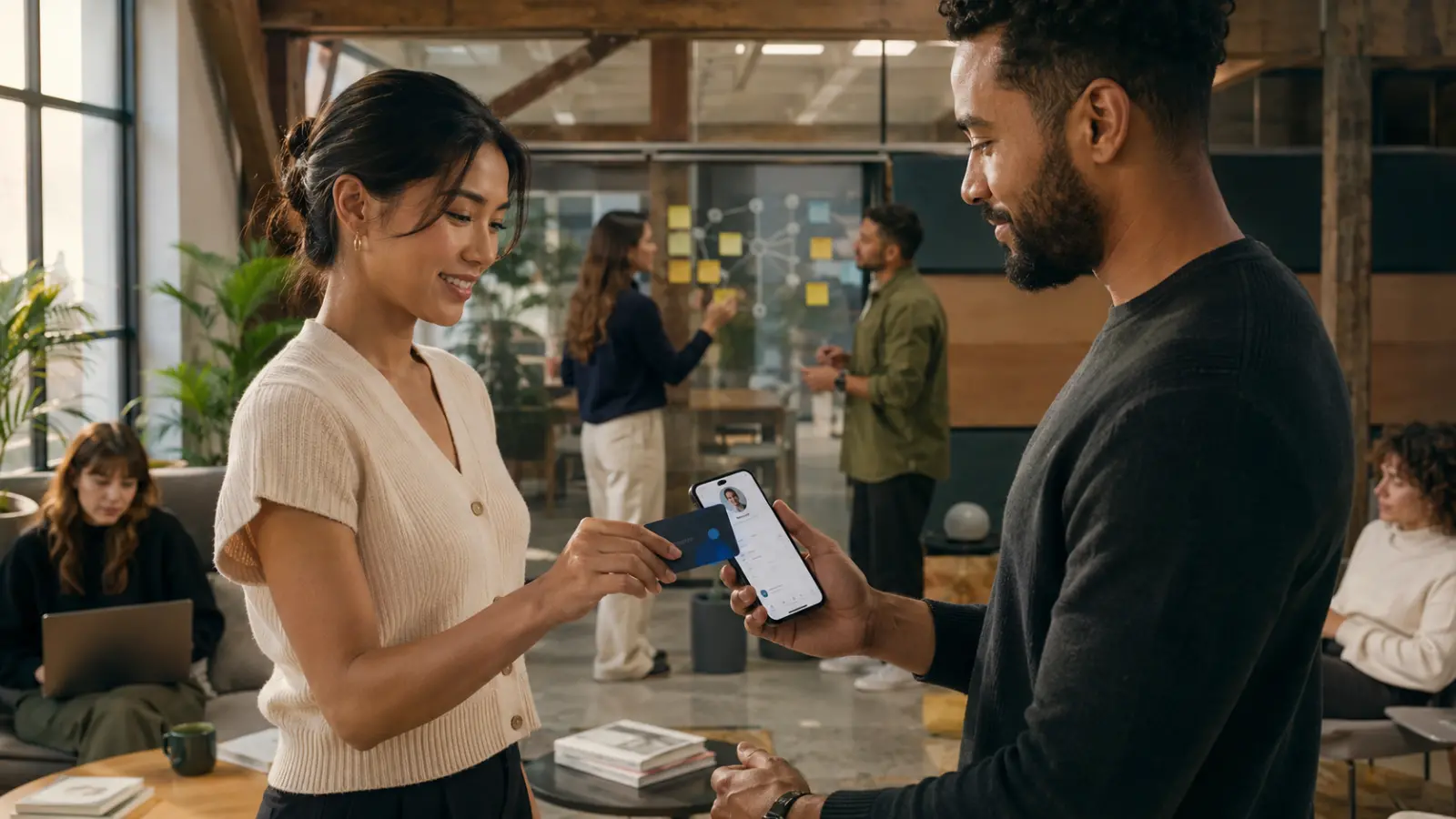
Instead of handing out a physical card that can be lost or thrown away, you share your details instantly from your smartphone, and the other person saves them to their contacts in a couple of taps.
A digital business card can include:
In practice, it works as a modern, highly efficient professional presentation hub.

Digital entrepreneurship demands agility, innovation, and adaptability. In that context, a digital business card offers advantages that go far beyond exchanging phone numbers.
It keeps you ready for any business opportunity, whether at an in-person meeting, a corporate event, a networking session, or an online conversation.
It also reinforces an image of modernity and innovation, qualities that customers value more every year.
Here are the eight benefits that matter most.
One of the biggest challenges entrepreneurs face is building authority in the digital environment.
A digital business card helps solve this challenge by bringing all your important information together in one place.
Instead of sending multiple links separately, you offer an organized, professional experience that makes it easy for people to find what they need.
This conveys credibility and strengthens positive brand perception from the very first contact.
Networking remains one of the most effective strategies for generating business opportunities.
The difference is that today, connections happen both in person and online.
With a digital business card, all it takes is bringing a smartphone close, showing a QR code, or sending a link for someone to gain immediate access to your information.
The process is fast, practical, and eliminates the need to type contact details manually.
This significantly increases the chances of the connection surviving beyond the first conversation.
In digital entrepreneurship, accessibility is crucial.
The easier it is for a potential customer to get in touch, the greater the chances of conversion.
A digital business card can include direct buttons for:
WhatsApp;
Instagram;
LinkedIn;
Facebook;
Email;
Corporate website;
Online store.
This removes friction from the communication process and makes it easier to start a business relationship.
Although printed business cards are still used in some industries, they have significant limitations.
In addition to printing costs, they must be reprinted whenever a phone number, address, or visual identity changes.
A digital business card, on the other hand, allows instant updates without recurring expenses.
The result is financial savings and greater flexibility to keep up with the growth of your business.
First impressions matter.
When entrepreneurs use modern digital solutions, they project an image that aligns with current market trends.
This can become an important competitive advantage, especially in industries where innovation is highly valued.
Customers and partners often associate this behavior with businesses that are organized, up to date, and prepared to meet today's demands.
Concern for sustainable practices continues to grow worldwide.
By replacing printed cards with digital versions, companies and professionals significantly reduce paper consumption and the other resources used in graphic production. Peer-reviewed life-cycle research found that digital cards have the lower environmental footprint at realistic usage scale.
In addition to benefiting the environment, this approach strengthens your image among increasingly environmentally conscious consumers.
One of the biggest problems with traditional business cards is outdated information.
Changed your phone number? Moved offices? Opened a new social media profile?
With a printed card, the outdated version stays in circulation until a new batch is printed.
With a digital business card, updates take minutes and become immediately available to everyone who has your link.
This ensures more efficient communication and helps prevent missed opportunities.
Digital entrepreneurship depends directly on being discoverable.
A digital business card lets you integrate several communication and marketing channels into a single platform.
As a result, you increase your exposure and make it easier for new customers to discover your brand.
Sharing also becomes much simpler, so satisfied contacts can recommend your services with a single tap.
Paper cards still have their place, but the numbers are not in their favor: 88% of paper business cards are thrown away within a week, according to Adobe. For an entrepreneur whose next client may come from any introduction, that is a lot of lost opportunities. Here is how the two options compare on the criteria that matter most.
| Criterion | Paper business card | Digital business card |
|---|
| Cost | Paid per batch, reprinted after every change | Free plan available, no reprints |
| Updating your details | Impossible without a new print run | Instant, for every contact who has your link |
| How it is shared | In person only, one card per person | QR code, NFC, link, email signature, social bios |
| What it holds | Name, title, phone, email | All of that plus links, portfolio, video, forms, catalog |
| Follow-up | Depends on the recipient keeping the card | Contact saved to the phone in two taps |
| Environmental impact | Paper, ink, and shipping for every batch | No physical waste |
Many people see a digital business card as simply a presentation tool, but its potential goes much further.
When structured properly, it can serve as a genuine sales channel.
This happens because it:
Facilitates immediate contact;
Directs visitors to conversion pages;
Showcases portfolios and case studies;
Displays products and services;
Reinforces brand credibility;
Encourages engagement on social media.
In practice, it becomes an extension of the entrepreneur's sales strategy: every introduction ends with a clear next step instead of a piece of cardstock.

Virtually any professional or company can benefit from this technology.
Among the main users are:
Regardless of the industry, the tool contributes to more efficient and professional communication.
Creating one takes a few minutes, and you do not need any design or technical skills. Here is the setup we recommend for entrepreneurs who want the card to generate business, not just store a phone number.
Create your account: sign up for free in the ClickCard web app or in the iOS and Android apps. One account works everywhere, and your cards stay in sync between the browser and your phone.
Choose a template: pick one of 137+ designs and apply your logo, brand colors, and a professional photo so the card looks like an extension of your business.
Add the channels that convert: WhatsApp, phone, email, website, social profiles, portfolio, and a contact form. Put the action you want most, such as a call or a quote request, at the top of the card.
Share it everywhere: show your QR code in meetings, tap an NFC card, add the link to your email signature and social bios, and save the card to Apple Wallet or Google Wallet so it is always one swipe away.
Follow up and measure: save the contacts you meet, follow up within 24 hours while the conversation is fresh, and use the analytics available on Premium plans to see which links people click most.
To take full advantage of a digital business card, it is essential to rely on a trustworthy, modern, and complete platform.
ClickCard was developed specifically for professionals who want to strengthen their digital presence and create smarter connections. It works in the browser and on iOS and Android, supports sharing by QR code, NFC, and link, and includes a free plan that never expires.
With the platform, you can centralize your information, share contact details in seconds, and give clients and partners a modern experience from the first interaction. Teams get the same benefits at scale, with consistent branding and centralized management through the enterprise plans.
By adopting a specialized solution, entrepreneurs gain efficiency, strengthen their brands, and increase their business opportunities.
Yes. ClickCard's Basic plan is free forever and includes 137+ card designs, unlimited sharing via QR code and custom link, and the business card scanner. Advanced features such as analytics, team management, and custom branding are available on Premium plans.
No. Whoever receives your card opens it in their browser, with nothing to install, and can save your details directly to their phone contacts.
You can display your QR code from the app or from your phone's wallet even without a connection. The person receiving it needs internet access to open your card and save your details.
A link in bio is a list of links. A digital business card is a contact profile: it is designed to be saved to a phone, shared by QR code or NFC, and updated centrally, and it can also include the same links, plus video, forms, and a product catalog.
Yes. Team and enterprise plans let a company create cards with a consistent brand identity, manage them centrally, and update everyone's details at once when something changes.
For most entrepreneurs, yes. You never run out, your details are always current, and the contact is saved on the spot. Many professionals still keep a few paper cards for people who prefer them and print the QR code on those cards so both paths lead to the same profile.
Digital entrepreneurship requires tools that connect people, strengthen brands, and make opportunities easier to generate.
In this context, the digital business card has become much more than an alternative to printed cards. It is a smart strategy for expanding your digital presence, improving your networking, strengthening credibility, and driving results.
If you are looking for a modern way to present your business, create more efficient connections, and keep pace with the market, investing in a digital business card is an important step.
Create your free digital business card in the ClickCard web app today, or talk to our team if you want to roll it out across your company.