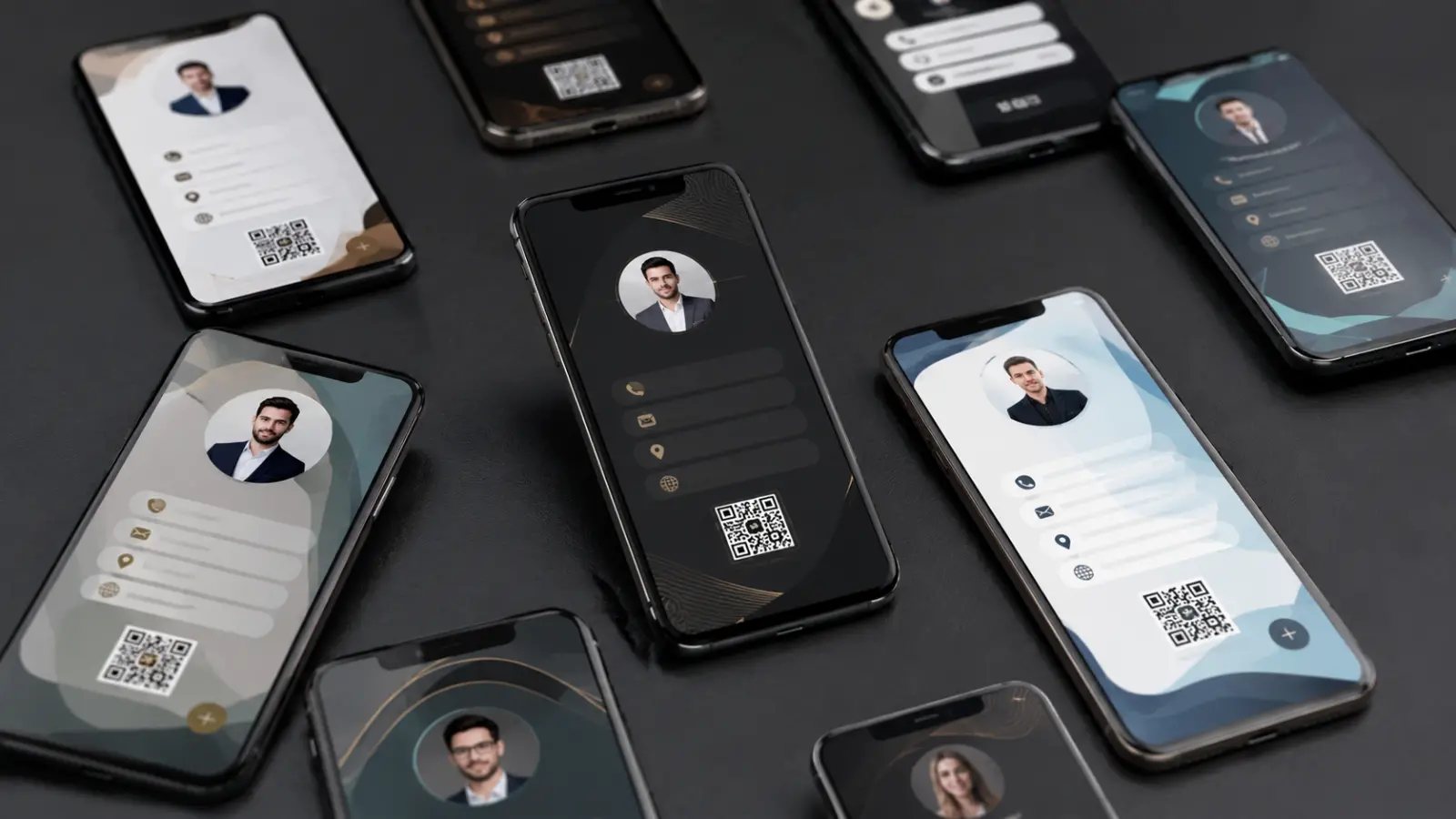
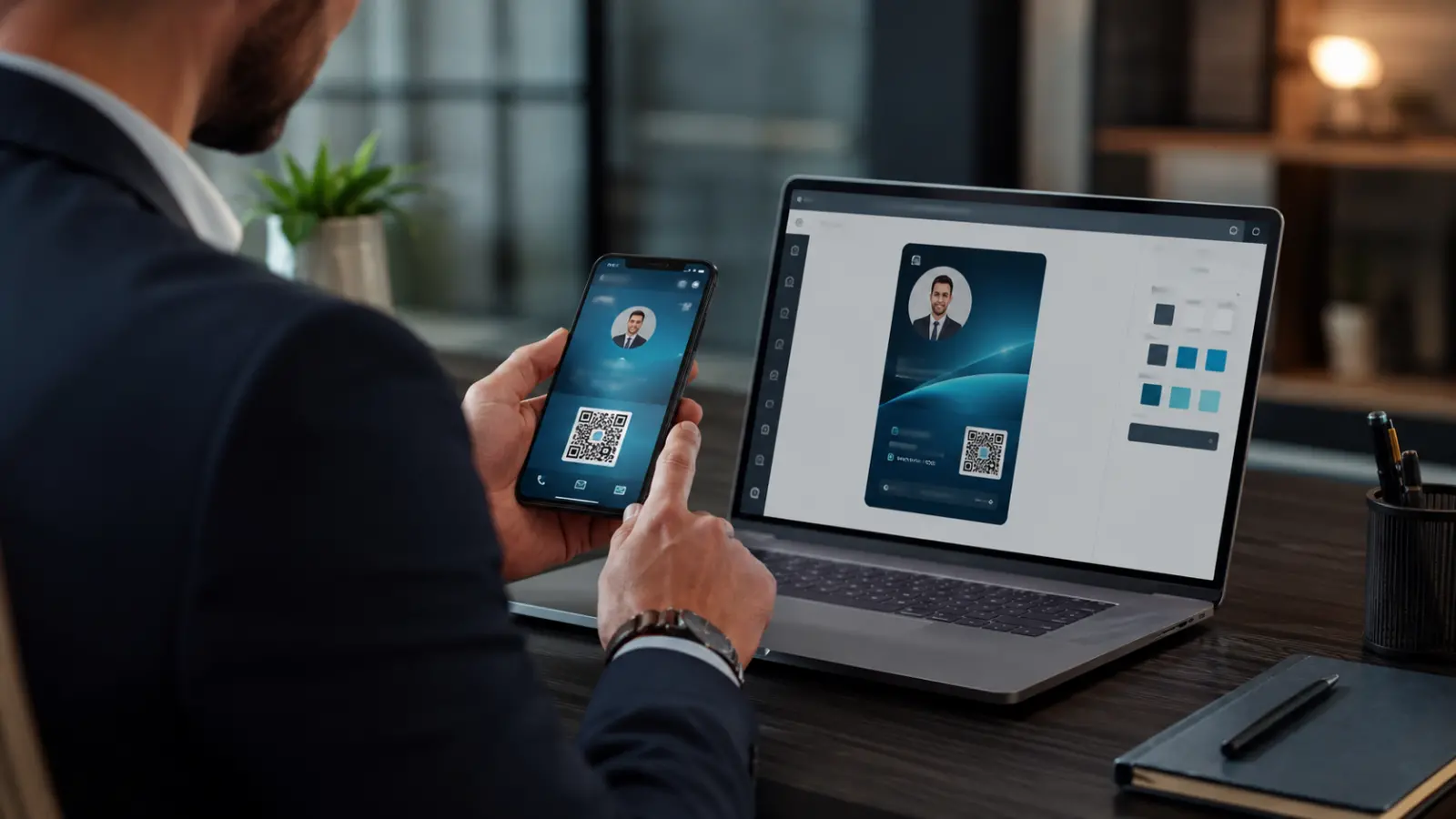
The digital business card is no longer a trend—it has become the standard for professionals, salespeople, and companies that want to share contact information quickly and professionally. Instead of printing hundreds of paper business cards, it is now possible to share information through QR codes, NFC, direct links, email signatures, and even Apple Wallet or Google Wallet.
But what is the best digital business card app?
In this guide, we analyze the leading platforms available in Brazil and around the world, comparing features, pricing, native mobile apps, NFC sharing, analytics, CRM integrations, and team management capabilities.
If you're looking for a professional digital business card solution for networking, sales, or corporate use, this comparison will help you choose the ideal platform.
We compared the eight most established platforms on the criteria that matter in daily use:

Free plan quality — can you run a complete, professional card without paying?
Sharing methods — QR code, NFC, link, email signature, Apple/Google Wallet.
Recipient experience — does the person you meet need an app? How fast does your card load?
Analytics — can you see who viewed your card and what they clicked?
Team features — central management, brand control, CRM integrations.
Maturity — how long the company has been on the market, and whether it ships a true native app or a web wrapper.
Pricing approach — subscription cost and whether physical NFC hardware is required.
One note before the list: pricing in this category changes often. Treat the pricing notes as directional and check each vendor's site for current numbers.

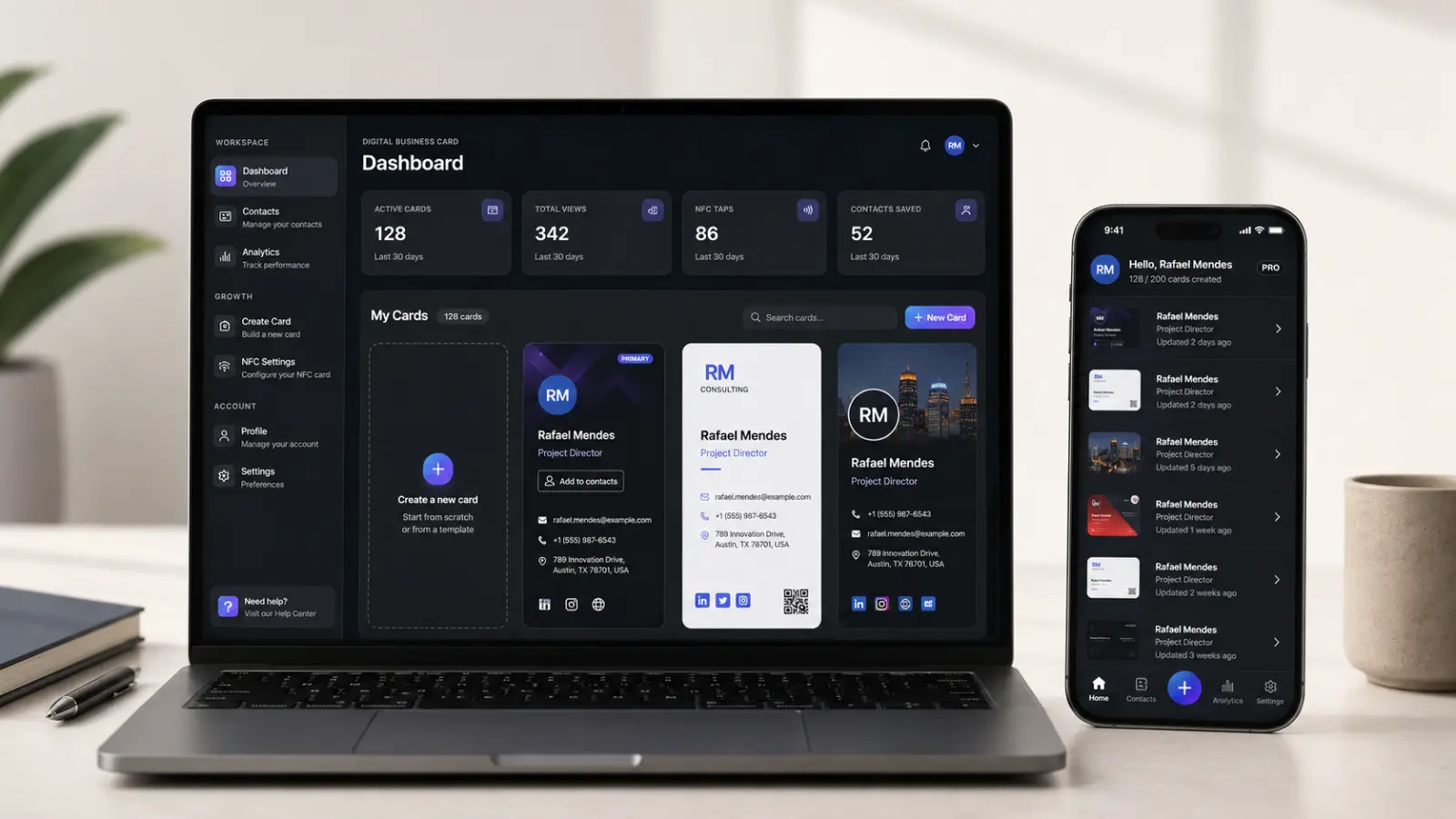
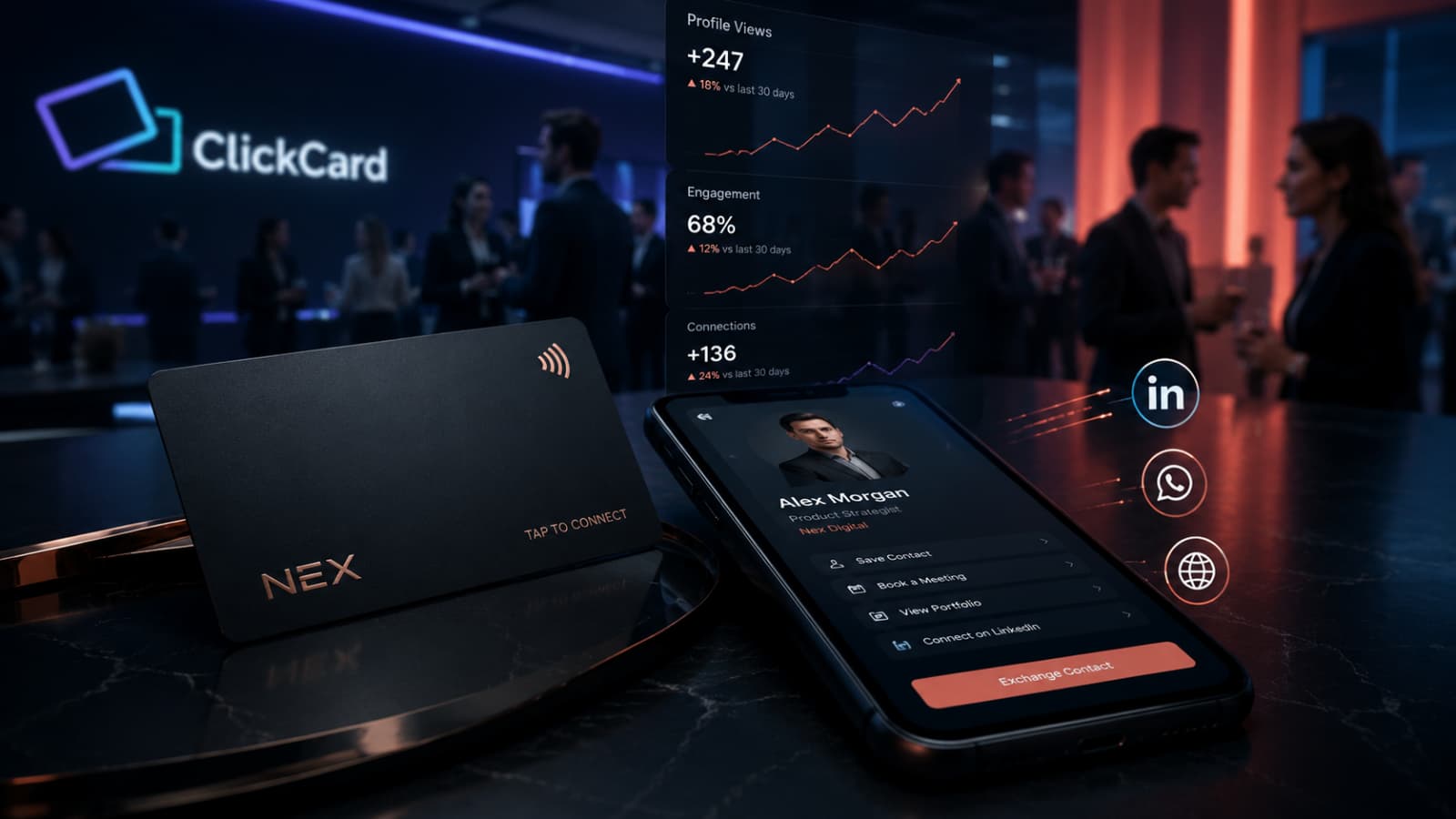
ClickCard (yes, ours) is a global company incorporated in the US, Brazil, and Chile, built around a simple thesis: a complete digital business card should be free, and premium should be cheap enough that a whole team can use it. The free plan includes a fully customizable card with QR code sharing and unlimited exchanges. Premium starts at $3.99/month (billed annually) and adds analytics, advanced customization, Apple/Google Wallet, physical NFC cards, and an AI scanner that digitizes the paper cards other people still hand you. Enterprise plans add centralized team management, SSO, and CRM integrations, the same stack used by 500+ companies and 200,000+ professionals in 50+ countries.
Native apps: iOS and Android · On the market since: 2018 (8 years)
Strengths: one of the lowest premium prices in the category, QR + NFC + wallet + link sharing in one app, team dashboard, AI card scanner, sustainability calculator for companies.
Weaknesses: Some advanced integrations are enterprise-only.
Best for: professionals who want everything in one app without a $10+/month subscription, and companies issuing cards to whole teams. Try it free.
Blinq is one of the most downloaded apps in the category and consistently top-rated on the App Store. Founded in Melbourne, it is also the oldest company on this list. Its free tier is generous for individuals and the card-creation flow is one of the smoothest available. Business plans target teams with admin controls and integrations.
Native apps: iOS and Android · On the market since: 2017 (9 years)
Strengths: polished UX, strong free plan, wide brand recognition.
Weaknesses: deeper customization and team features move you to paid tiers quickly; NFC hardware sold separately.
Best for: individuals who want a simple, reliable free card from a big-name app. See our detailed ClickCard vs Blinq comparison.
HiHello pioneered the idea of carrying several cards in one app, work, personal, side project, and remains excellent at it. Founded in Palo Alto the same year as ClickCard, it also generates email signatures and virtual video-call backgrounds from your card.
Native apps: iOS and Android · On the market since: 2018 (8 years)
Strengths: multi-card management, email signature generator, solid free plan.
Weaknesses: the most useful extras (analytics, integrations) sit in higher tiers; physical cards cost extra.
Best for: consultants and people juggling several professional identities. Full breakdown: ClickCard vs HiHello.
Popl leans hard into sales teams and event networking: badge scanning, lead-capture forms, and a large integration catalog. It started as an NFC hardware company in Los Angeles and still sells a wide accessory line.
Native apps: iOS and Android · On the market since: 2019 (7 years)
Strengths: lead capture at events, strong integrations, broad hardware lineup.
Weaknesses: per-user pricing is among the highest in the category once teams and integrations are involved.
Best for: sales orgs that live at trade shows and need leads in the CRM the same day. We compare features and pricing in ClickCard vs Popl.
V1CE has taken over the hardware-centric crown, pairing its robust software ecosystem with the highest-quality physical products on the market—including luxury metal, wood, and plastic NFC cards. Their platform includes advanced contact-tracking features and unique profile modes.
Native apps: iOS and Android companion features (primarily browser-first) · On the market since: 2020
Strengths: Unmatched premium card materials, multiple profile modes (Direct Link vs. Landing Page), no required subscription for basic hardware usage.
Weaknesses: High initial cost for physical hardware; advanced enterprise analytics require professional tiers.
Mobilo focuses on companies: wood and metal NFC cards, team dashboards, and lead-routing rules that send scanned contacts straight into the CRM.
Native apps: iOS and Android · On the market since: 2019 (7 years)
Strengths: premium card materials, team administration, lead routing.
Weaknesses: individual users pay hardware-first; the free experience is limited compared with app-first competitors.
Best for: companies that want branded physical cards as employee gifts with software behind them. Comparison: ClickCard vs Mobilo.
dot.cards sells NFC products with no subscription: buy the card or tag once and your profile is included. That makes it the cheapest long-run option for casual users, with correspondingly lighter software.
Native apps: none required, the product is deliberately app-free, with only a minimal companion app · On the market since: 2020 (6 years)
Strengths: no recurring fee, simple setup.
Weaknesses: minimal analytics and team features; the profile is more a contact page than a managed card.
Best for: occasional networkers who hate subscriptions.
Wave combines an inexpensive NFC card with a free app and unlimited sharing, positioning itself as the affordable end of the hardware-plus-app segment.
Native apps: web-first, its mobile apps are wrappers around the web platform rather than fully native apps · On the market since: 2020 (6 years)
Strengths: low-cost entry, free app tier, simple team offering.
Weaknesses: fewer advanced features and integrations than the enterprise-focused tools.
Best for: individuals and small teams that want a physical card on a budget.
All eight platforms share via QR code, so we compare the points where they actually differ:
| App | Founded | Native app | Free card | NFC | Wallet | Analytics | Team mgmt |
|---|
| ClickCard | 2018 | iOS + Android | Yes | Yes | Yes | Premium | Yes |
| Blinq | 2017 | iOS + Android | Yes | Hardware | Yes | Paid | Yes |
| HiHello | 2018 | iOS + Android | Yes | Hardware | Yes | Paid | Yes |
| Popl | 2019 | iOS + Android | Yes | Hardware | Yes | Paid | Yes |
V1CE | 2020 | Yes (Hybrid) | Limited | Included | Yes | Included | Yes |
| Mobilo | 2019 | iOS + Android | Limited | Hardware | Yes | Paid | Yes |
| dot.cards | 2020 | App-free | With hardware | Yes | Limited | Basic | Limited |
| Wave | 2020 | Web wrapper | Yes | Hardware | Yes | Paid | Yes |

You want the best value with all sharing methods: ClickCard.
You want the most familiar free app: Blinq.
You manage several identities: HiHello.
You run a field sales team at events: Popl or Mobilo.
You want luxury, high-end physical hardware: V1CE.
You refuse to pay a subscription: dot.cards.
You want the cheapest physical card: Wave.
ClickCard, Blinq, and HiHello all offer complete free cards with QR sharing. The difference appears when you need extras: ClickCard's premium tier ($3.99/month annually) is among the cheapest paths to analytics, wallet passes, and NFC.
No. A QR code on your phone screen does the same job and works with every smartphone camera. NFC cards feel more premium and are slightly faster in person, which is why sales teams like them, but they are optional with app-first platforms like ClickCard, Blinq, and HiHello, and mandatory with hardware-first ones like dot.cards.
No, on all eight platforms. The recipient scans or taps and your card opens in their web browser, where they can save your contact directly to their phone.
Blinq is the oldest on this list (founded 2017), followed by ClickCard and HiHello (both 2018), then Popl and Mobilo (2019), and dot.cards Wave and V1CE (2020). Longevity matters here: your card's link and QR codes only keep working as long as the company behind them does, so an established platform is a real consideration, especially if you print a QR code on physical materials.
ClickCard, Popl, and Mobilo have the strongest enterprise stories, central dashboards, brand control, and CRM integrations. The practical difference is cost per seat and which CRM you run; request quotes from each before committing.
Any app on this list beats paper. If you want the shortest path to a professional card with every sharing method and a team option that doesn't break the budget, create your free ClickCard in about five minutes, and if you're still weighing options, our comparison hub goes deeper on every matchup in this article.