As business becomes increasingly digital, physical business cards are growing less and less efficient for companies that need agility, standardization, and the ability to track results. Today, simply owning a digital card is no longer enough. You need to manage corporate networking strategically.
This is exactly where the ClickCard Web Dashboard comes in.
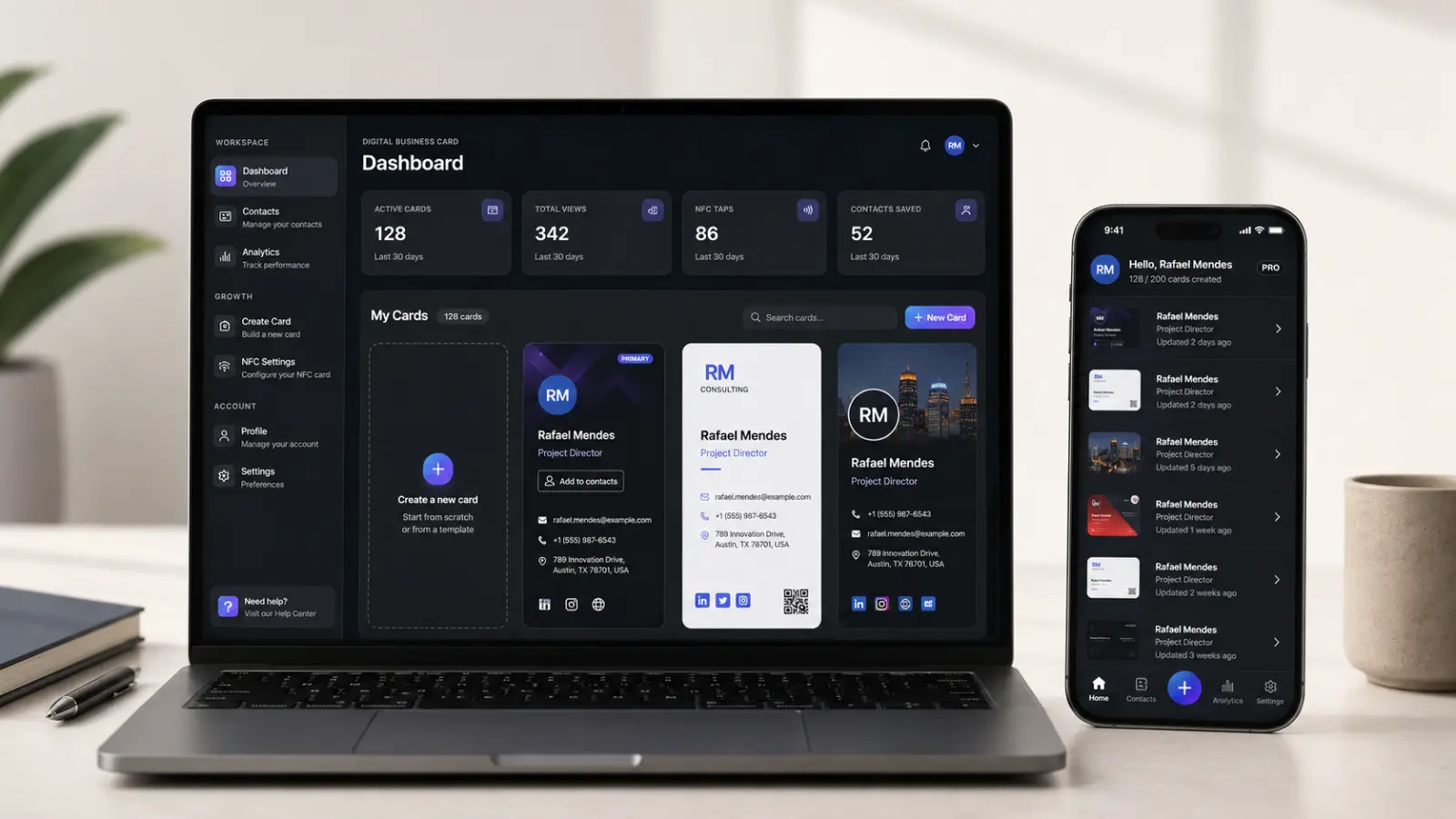
More than a platform for creating digital business cards, the Web Dashboard works as an intelligent management hub, allowing companies to control, analyze, and optimize how their teams connect with clients, partners, and business opportunities.
Instead of relying on manual processes and scattered information, your company gains full control over the digital cards used by employees, along with access to metrics, integrations, and strategic reports.
The challenge for companies without centralized management

In many companies, digital business cards end up being managed individually by the employees themselves. This creates several problems:
Outdated information;
Lack of visual standardization;
Difficulty tracking results;
Loss of important contacts;
No control when employees leave or teams change;
No real metrics on networking and prospecting.
Imagine a sales team with dozens of reps attending events, trade shows, and meetings every day. Without a centralized dashboard, each employee manages their own contacts and cards, making it nearly impossible for the company to track the impact of those connections.
The ClickCard Web Dashboard solves exactly this problem.
1. Centralized management and brand standardization
A company's visual identity is a strategic asset. With the Web Dashboard, administrators (usually from HR, Marketing, or Sales) can control all of the team's digital cards in a single environment.
This makes it possible to:
Standardize corporate information;
Ensure visual brand consistency;
Update data quickly;
Request new cards easily;
Activate or deactivate cards instantly.
This control is especially important when employees join or leave, preventing outdated information from continuing to circulate in the market.
2. The end of guesswork: real networking metrics

In traditional networking, it's common to hand out physical cards without ever knowing whether any further interaction happened. With the ClickCard Web Dashboard, your connections start generating strategic data.
The platform lets you track:
Number of views;
Link clicks;
Shares;
QR Code scans;
Engagement per card;
Most-accessed information;
Individual and team-wide reports.
With these metrics, managers can identify:
Which professionals are most engaged;
Which strategies are working best;
Which approaches generate the most interest.
Networking stops being based on perception and becomes data-driven.
3. Smart contact organization with OCR technology
Corporate events tend to generate a huge number of contacts. Organizing that information manually can be time-consuming and error-prone.
ClickCard uses OCR (Optical Character Recognition) technology to scan the physical cards you receive and automatically extract information such as:
Name;
Company;
Job title;
Phone number;
Email.
This lets you build a far more organized and accessible contact library.
On top of that, contacts can be categorized by:
Industry;
Location;
Interest;
Team;
Sales priority.
This kind of organization makes strategic follow-ups easier and keeps important opportunities from slipping through the cracks.
4. Integration with CRM and sales tools

A digital business card shouldn't work in isolation.
The ClickCard Web Dashboard can integrate information with the platforms your company already uses, such as:
CRM;
Marketing automation;
Analytics tools;
Sales systems.
This speeds up the sales process and improves tracking of the leads generated through corporate networking.
In practice, this means:
Less rework;
More organization;
Greater sales speed;
Better use of opportunities.
5. Sustainability and broader reach
Beyond the operational benefits, digital management also supports more sustainable practices.
By replacing physical cards with digital versions, a company reduces:
Paper consumption;
Waste;
Recurring printing costs.
What's more, digital cards can be shared in many different ways:
Link;
QR Code;
PDF;
NFC;
Messaging apps;
Social media.
This significantly expands the reach of your professional connections.
How the Web Dashboard strengthens corporate networking
Managing digital cards isn't just about organizing contacts. In practice, it means strengthening professional relationships and turning networking into real business opportunities.
Efficient management helps a company:
Grow its network
Well-maintained relationships create more lasting and valuable connections.
Generate new opportunities
Organized teams stay top of mind for clients and partners.
Build credibility
A modern, standardized, and accessible company comes across as more professional.
Improve sales follow-up
With organized contacts and available metrics, follow-up becomes far more efficient.
Keep the team up to date
Quickly sharing information makes strategic connections and knowledge exchange easier.
Comparison: traditional management vs. smart management

Scenario | Traditional Management | Smart Management with ClickCard |
|---|---|---|
Card control | Individual and decentralized | Centralized by the administrator |
Data updates | Manual and slow | Instant |
Metrics | Nonexistent | Complete reports |
Networking | No tracking | Monitored in real time |
Contact organization | Manual | Automated with OCR |
Sharing | Limited to physical | QR Code, NFC, link, and PDF |
Sustainability | High paper use | 100% digital solution |
The real impact of the Web Dashboard
Companies that invest in smart digital card management can turn networking into a strategic growth tool.
With more control, metrics, and integration, the ClickCard Web Dashboard helps teams:
Improve connections;
Strengthen the brand;
Accelerate sales;
Optimize customer relationships;
Professionalize internal processes.
More than replacing physical cards, the goal is to completely modernize how your company connects with the market.
Conclusion
Digital business cards are already a reality in the corporate world. But for companies that want scale, organization, and sales intelligence, simply creating cards isn't enough.
The ClickCard Web Dashboard provides everything you need to centralize the management of your team's cards, track real metrics, integrate sales data, and turn networking into concrete results.
By leaving manual processes behind and adopting smart connection management, your company gains more agility, professionalism, and efficiency.
Want to turn your team's networking into a strategic tool?
Explore the ClickCard Web Dashboard and discover how to centralize, analyze, and optimize your company's connections in a modern, smart, and sustainable way.

Enjoyed this article? Follow us on Google